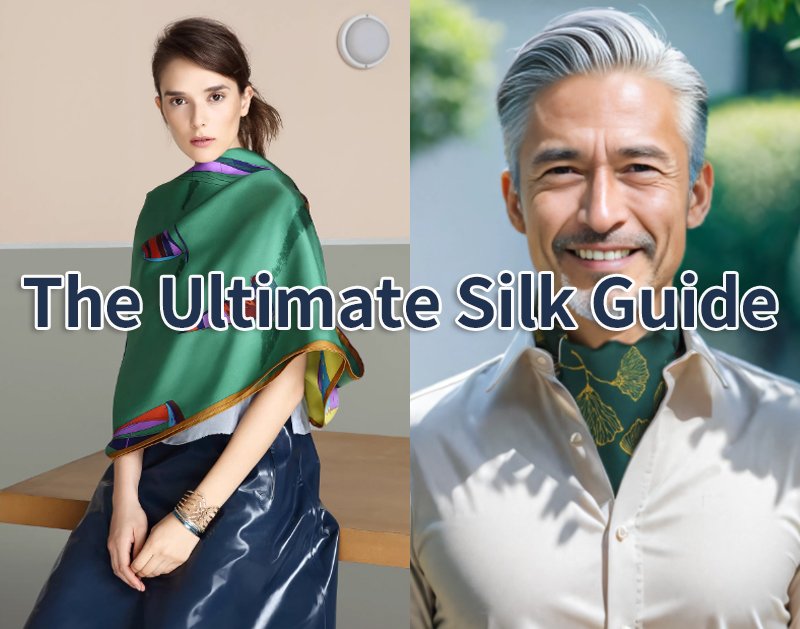
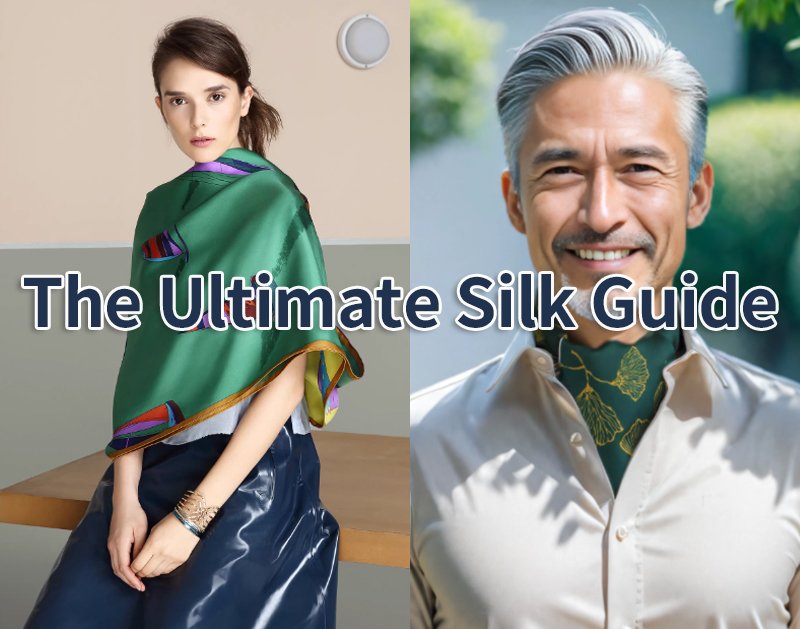
Silk Scarves isn’t just an accessory — it’s an easy way to make any outfit look intentional and elevated. You see them on Paris streets, New York runways, and everywhere in between. A well-made 100% Mulberry silk scarf can instantly upgrade jeans and a tee or add polish to a blazer.
Before you buy, though, many people ask: why is one scarf $20 and another (like a Hermès silk scarf) hundreds of dollars? And once you have one, how do you tie a silk scarf so it looks stylish rather than like a uniform?
We’re a team with long experience in silk. Below are the practical things you actually need to know — from spotting real mulberry silk to 10 easy, fashionable ways to tie it.
1. Skip the Rip-Offs: How to Tell Real, High-Quality Silk
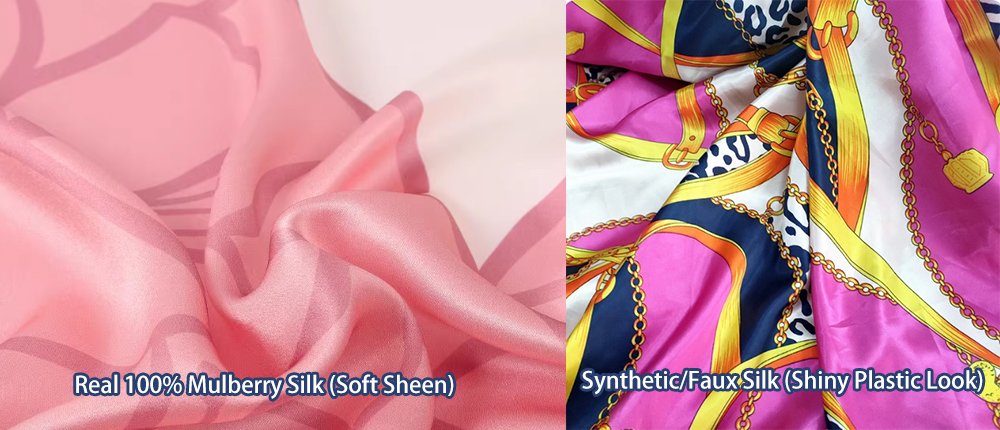
When you search for silk scarves for women or a mens silk scarf, material should be your first filter. Lots of products say “silky” but are just polyester. Real silk quality comes down to three things:
Look at the fiber: it should be 100% Mulberry silk.
Mulberry silk comes from a controlled diet (mulberry leaves) and produces long, smooth protein fibers. The fabric has a soft, pearl-like sheen, is breathable, and is gentler on hair and skin — so it’s a better choice if you plan to use it as a hair scarf.
Check the grade and the momme (weight).
Grade 6A is commonly considered high-quality raw silk — longer, stronger fibers. Momme (abbreviated “mm”) measures the fabric weight. Typical square scarves are 12–14 momme; higher-end scarves are usually 16–19 momme or more, giving better hand-feel and drape. For a scarf that lasts and drapes well, aim for at least 16 momme.
Inspect the finish: hand-rolled edges matter.
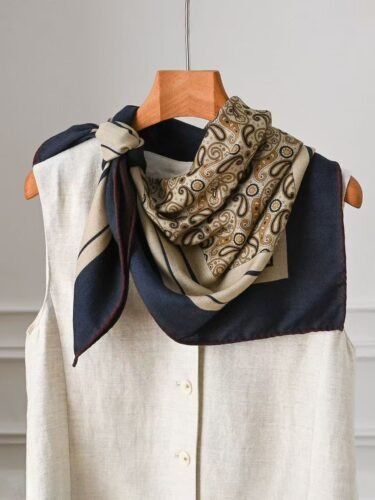
High-end scarves (think Hermès, Ferragamo) use hand-rolled edges — the seam is rounded and the stitches are tiny. Machine-locked edges are fine for budget pieces but lack the refined look and feel.
2. 10 Practical, Stylish Ways to Tie a Silk Scarf (with when to use each)
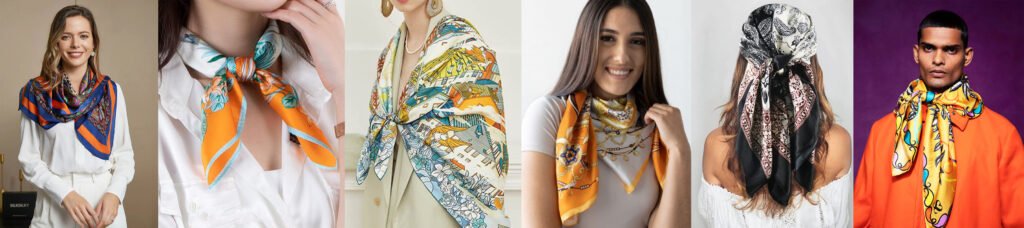
These work for different sizes: 50×50 cm (bandana/small square), 90×90 cm (classic large square), and long rectangular scarves.
- Classic Neck Knot — Work / Commuting
Fold a long scarf into a narrow strip, wrap once around your neck, and tie a flat knot so the knot’s center shows. Clean, professional. - Parisian (European) Knot — Everyday Polished
Fold a square into a triangle, roll the long edge into a band, drape around the neck, pull ends through the loop and adjust. Effortless and elegant. - Ascot-style Knot — Formal / Vintage Vibe
Drape a long scarf inside your shirt or under a blazer collar and tie a fuller knot that sits at the throat. Works well with blazers or collared shirts. - Slip-Through Knot — Modern Minimal
Make a small loop with one end (or use a discrete scarf ring), thread the other end through and tighten. Simple and secure. - Choker Twist — Night Out / Trendy
Wrap a long narrow scarf twice around the neck, tighten to sit higher, and tuck or knot at the back — gives a necklace-like effect. - Front Bow Accent — Feminine / Cute
Fold a square into a strip, tie a small bow at the collarbone or on one side of a shirt for a playful detail. - Bandana Head Wrap — Retro / Protects Hair
Fold a small square into a triangle, place over the hairline, tie under the nape or at the chin. Great for protecting hair at night or adding vintage flair. - Small Turban / Headwrap — Boho / Statement
Use a larger square or long scarf to wrap and twist on the crown; tuck the ends. Good for strong-statement looks. - Bag Twilly — Revive an Old Bag
Wrap a narrow scarf (a “twilly”) around the handle and knot the ends. Instant lift for a worn bag — think Hermès Twilly styling. - Wrist Wrap — Accessory Trick
Fold into a band and wrap twice around the wrist, tie a small knot. Works like a bracelet and ties accessory colors together.
3. Silk Scarf vs. Silk Bandana: Pick by Use
- Silk Scarf: Usually 90×90 cm or larger. Good for draping, complex knots, and prints that tell a story — ideal for formal looks and statement pieces.
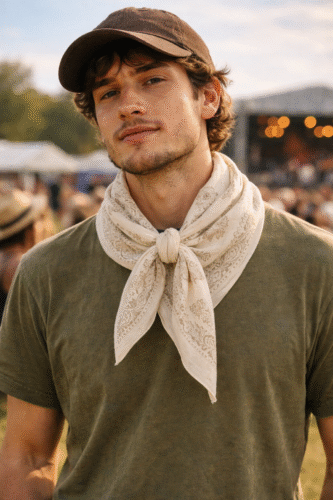
- Silk Bandana / Small Square: Usually 50×50–55×55 cm. Streetwear-friendly, unisex, and great as a headscarf, neckerchief, or wrist wrap. Also the easiest entry point for a mens silk scarf.
4. Why Prices Vary So Much
Three factors drive price: fiber (100% mulberry silk vs. synthetics), momme (fabric weight), and construction (hand-rolled edges, print quality, colorfastness). Luxury brands also charge for heritage, craftsmanship, and limited designs — you’re paying for materials and workmanship.
5. Quick Care: Treat Your Silk Like Skin
Silk is a protein fiber — handle it gently.
- Washing: Prefer hand wash or dry clean. Use a silk-specific detergent, cold water, and gentle pressing — don’t wring.
- Drying: Avoid direct sun; lay flat or hang to dry in shade.
- Ironing: Use low heat or steam, iron on the reverse side or with a press cloth.
- Storage: Fold and store away from jewelry or sharp items; use acid-free tissue for long-term storage.
6. FAQ (Short, Practical Answers)
Q: Is higher momme always better?
A: Higher momme generally means heavier, more durable silk and better drape — but also more weight and cost. 16–19 momme is a good balance for everyday luxury.
Q: How can I be sure it’s real silk?
A: Real silk has a soft hand, natural sheen that shifts with light, and breathes. The definitive proof is reliable product labeling, brand transparency, and any test/certification — avoid DIY burn tests unless you know what you’re doing.
Q: What styles work for men?
A: Small squares (50×50 cm) or narrow long scarves worn with a jacket, denim, or leather are classic. Stick to neutral or restrained patterns for a modern look.