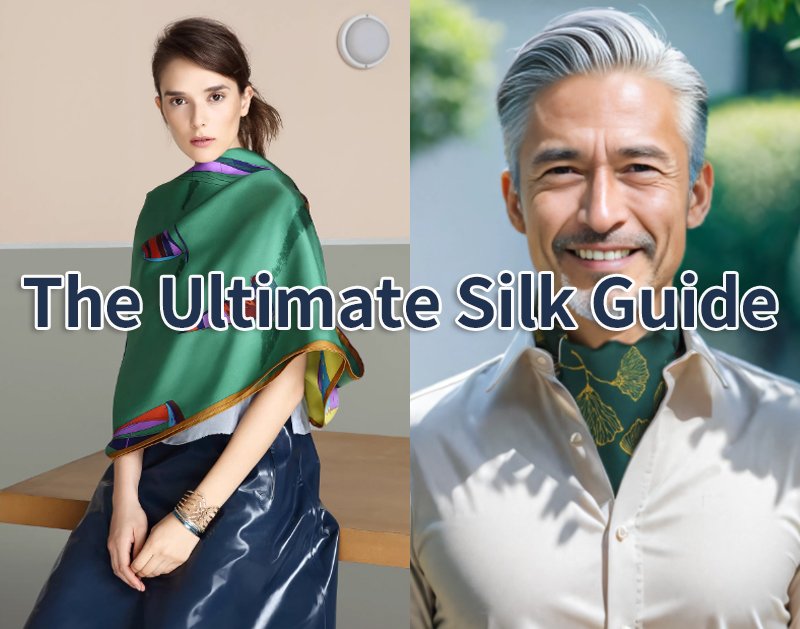
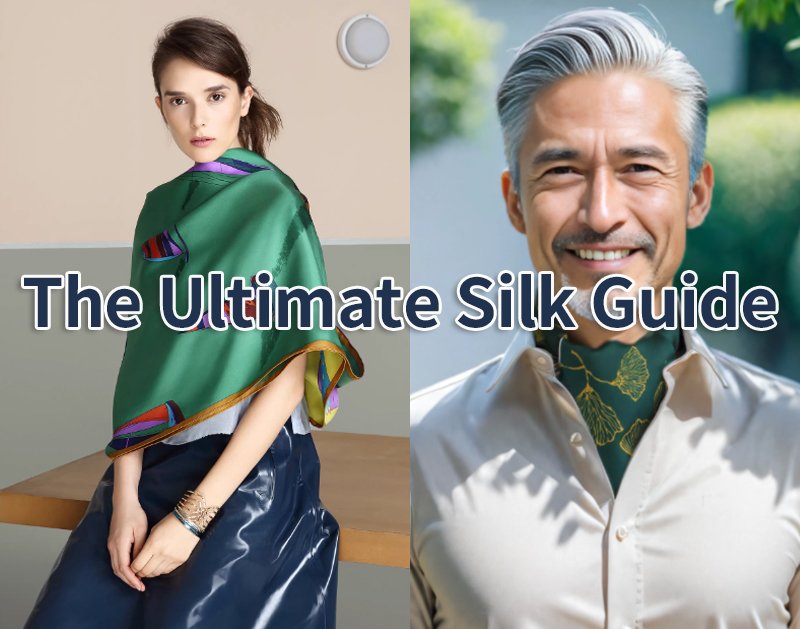
Silk Scarves isn’t just an accessory — it’s an easy way to make any outfit look intentional and elevated. You see them on Paris streets, New York runways, and everywhere in between. A well-made 100% Mulberry silk scarf can instantly upgrade jeans and a tee or add polish to a blazer.
Before you buy, though, many people ask: why is one scarf $20 and another (like a Hermès silk scarf) hundreds of dollars? And once you have one, how do you tie a silk scarf so it looks stylish rather than like a uniform?
We’re a team with long experience in silk. Below are the practical things you actually need to know — from spotting real mulberry silk に 10 easy, fashionable ways to tie it.
1. Skip the Rip-Offs: How to Tell Real, High-Quality Silk
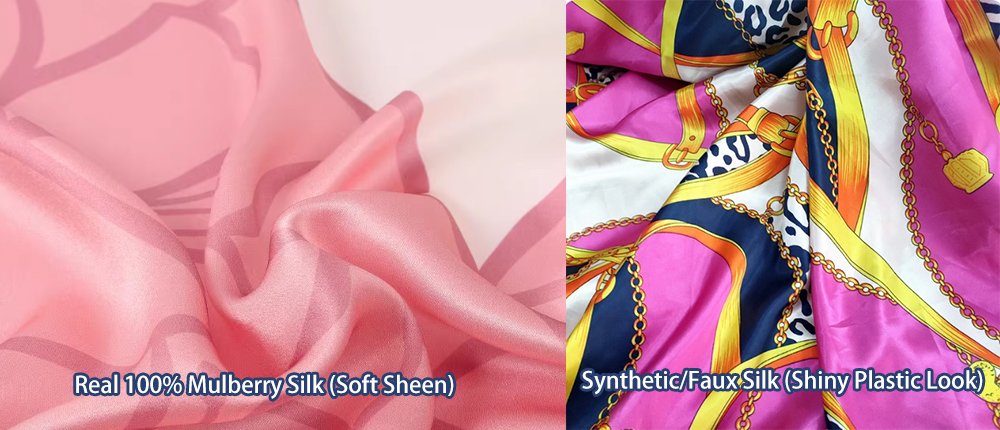
When you search for silk scarves for women または mens silk scarf, material should be your first filter. Lots of products say “silky” but are just polyester. Real silk quality comes down to three things:
Look at the fiber: it should be 100% Mulberry silk.
Mulberry silk comes from a controlled diet (mulberry leaves) and produces long, smooth protein fibers. The fabric has a soft, pearl-like sheen, is breathable, and is gentler on hair and skin — so it’s a better choice if you plan to use it as a hair scarf.
Check the grade and the momme (weight).
Grade 6A is commonly considered high-quality raw silk — longer, stronger fibers. Momme (abbreviated “mm”) measures the fabric weight. Typical square scarves are 12–14 momme; higher-end scarves are usually 16–19 momme or more, giving better hand-feel and drape. For a scarf that lasts and drapes well, aim for at least 16 momme.
Inspect the finish: hand-rolled edges matter.
High-end scarves (think Hermès, Ferragamo) use hand-rolled edges — the seam is rounded and the stitches are tiny. Machine-locked edges are fine for budget pieces but lack the refined look and feel.
2. 10 Practical, Stylish Ways to Tie a Silk Scarf (with when to use each)
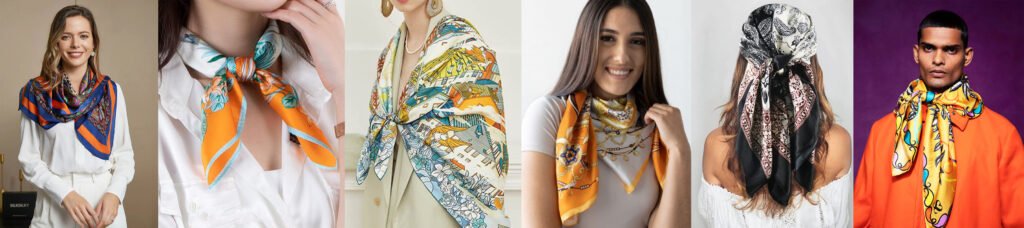
These work for different sizes: 50×50 cm (bandana/small square), 90×90 cm (classic large square), and long rectangular scarves.
- Classic Neck Knot — Work / Commuting
Fold a long scarf into a narrow strip, wrap once around your neck, and tie a flat knot so the knot’s center shows. Clean, professional. - Parisian (European) Knot — Everyday Polished
Fold a square into a triangle, roll the long edge into a band, drape around the neck, pull ends through the loop and adjust. Effortless and elegant. - Ascot-style Knot — Formal / Vintage Vibe
Drape a long scarf inside your shirt or under a blazer collar and tie a fuller knot that sits at the throat. Works well with blazers or collared shirts. - Slip-Through Knot — Modern Minimal
Make a small loop with one end (or use a discrete scarf ring), thread the other end through and tighten. Simple and secure. - Choker Twist — Night Out / Trendy
Wrap a long narrow scarf twice around the neck, tighten to sit higher, and tuck or knot at the back — gives a necklace-like effect. - Front Bow Accent — Feminine / Cute
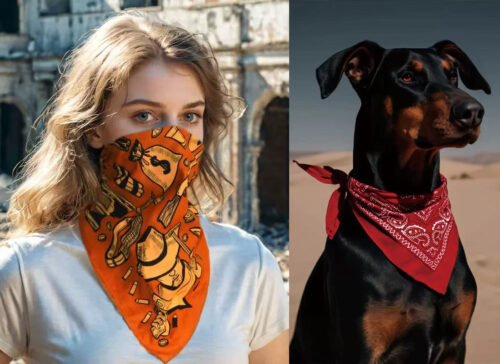
Fold a square into a strip, tie a small bow at the collarbone or on one side of a shirt for a playful detail. - Bandana Head Wrap — Retro / Protects Hair
Fold a small square into a triangle, place over the hairline, tie under the nape or at the chin. Great for protecting hair at night or adding vintage flair. - Small Turban / Headwrap — Boho / Statement
Use a larger square or long scarf to wrap and twist on the crown; tuck the ends. Good for strong-statement looks. - Bag Twilly — Revive an Old Bag
Wrap a narrow scarf (a “twilly”) around the handle and knot the ends. Instant lift for a worn bag — think Hermès Twilly styling. - Wrist Wrap — Accessory Trick
Fold into a band and wrap twice around the wrist, tie a small knot. Works like a bracelet and ties accessory colors together.
3. Silk Scarf vs. Silk Bandana: Pick by Use
- Silk Scarf: Usually 90×90 cm or larger. Good for draping, complex knots, and prints that tell a story — ideal for formal looks and statement pieces.
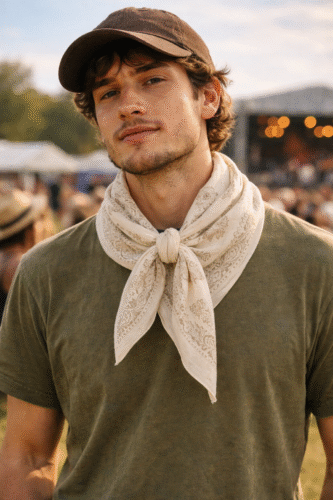
- Silk Bandana / Small Square: Usually 50×50–55×55 cm. Streetwear-friendly, unisex, and great as a headscarf, neckerchief, or wrist wrap. Also the easiest entry point for a mens silk scarf.
4. Why Prices Vary So Much
Three factors drive price: fiber (100% mulberry silk vs. synthetics), momme (fabric weight)、 そして construction (hand-rolled edges, print quality, colorfastness). Luxury brands also charge for heritage, craftsmanship, and limited designs — you’re paying for materials そして workmanship.
5. Quick Care: Treat Your Silk Like Skin
Silk is a protein fiber — handle it gently.
- Washing: Prefer hand wash or dry clean. Use a silk-specific detergent, cold water, and gentle pressing — don’t wring.
- Drying: Avoid direct sun; lay flat or hang to dry in shade.
- Ironing: Use low heat or steam, iron on the reverse side or with a press cloth.
- Storage: Fold and store away from jewelry or sharp items; use acid-free tissue for long-term storage.
6. FAQ (Short, Practical Answers)
Q: Is higher momme always better?
A: Higher momme generally means heavier, more durable silk and better drape — but also more weight and cost. 16–19 momme is a good balance for everyday luxury.
Q: How can I be sure it’s real silk?
A: Real silk has a soft hand, natural sheen that shifts with light, and breathes. The definitive proof is reliable product labeling, brand transparency, and any test/certification — avoid DIY burn tests unless you know what you’re doing.
Q: What styles work for men?
A: Small squares (50×50 cm) or narrow long scarves worn with a jacket, denim, or leather are classic. Stick to neutral or restrained patterns for a modern look.